

Our Belief about Teaching and Learning
At The District School, we believe the purpose of education is holistic formation — forming hearts to know God’s love, forming minds to love enduring truths and curiously engage in learning, and forming character and hands of service.
We believe that…
-
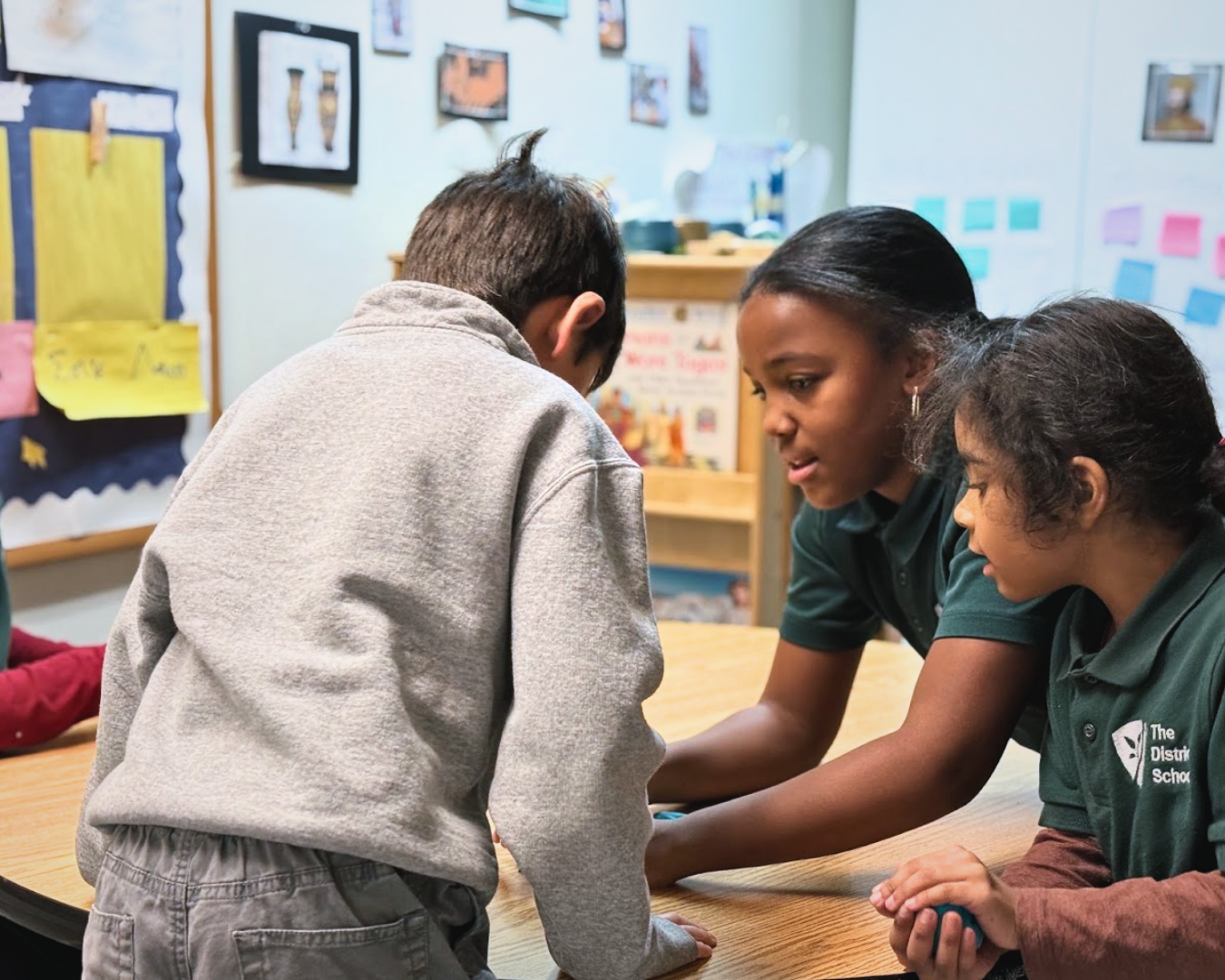
Every child is created in God's image and has dignity, innate gifts, passions, and incredible potential. The District School recognizes this divine imprint and sees children as capable of meeting high standards in academics and character development. We provide learning experiences that:
-Enrich students’ lives academically, emotionally, socially, creatively, and spiritually.
-Engage different learning modalities, for example, students conduct science experiments, engage in dramatic presentations, read rich texts, create art and music, and conduct field studies.
-Develop students' habits and character.
-
The District School offers an integrated curriculum, bringing together fields of study and forming a common narrative grounded in big ideas and questions. We provide learning experiences that:
-Expose children to a wide range of ideas and concepts.
-Teach students to recognize the connections between literature, art, music, history, and science.
-Connect learning to the Big Story of God.
-
At The District School, students create beautiful, high-quality work and share their work publicly for feedback and celebration. We provide learning experiences that:
-Allow students to learn from models of excellence and imitate beautiful work.
-Promote a supportive culture and integrate routines for peer and expert descriptive feedback on student work.
-Develop their ability to think, speak, and write creatively and analytically with precision and eloquence.
-
As students grow in wisdom and knowledge, students both change and become agents of change in their relationships and community. We provide learning experiences that:
-Point them to the good news of God’s infinite love and paint a picture of how God calls us to live, in light of that love.
-Give students concrete opportunities to apply their learning to meet the real needs of their community.
Our Curriculum
Humanities
Humanities combines literature, history, Scripture, science, and the arts, helping children see humanities as one great story between God and His creation. In lower elementary, students will conduct interdisciplinary investigations and develop literacy skills, content knowledge, habits of inquiry, and craftsmanship through theme-based units in the EL Curriculum. Additionally, we will leverage the Story of The World, story-filled texts that present the history of the world from ancient times to the modern ages.
Early Literacy
The foundations of reading are emphasized in grades K-2, equipping students with strong skills to open up new worlds of learning. The District School will use UFLI, an explicit and systematic program that teaches students the foundational skills necessary for proficient reading. Explicit phonics instruction is reinforced by substantive vocabulary development in science and history through the EL Curriculum to develop deeper literacy skills.
Math
The District School will use Singapore Math. This curriculum focuses on rigor, coherence, and focus in math instruction so students gain a deeper understanding of the patterns and why behind numbers. The lessons are engaging, encourage student dialogue, and apply math to real-life situations.
Science
When studying science, students practice the habits of scientists — observing carefully, asking questions, forming hypotheses, testing and making models, observing patterns, understanding processes, and drawing conclusions. A primary goal of studying science is to observe and wonder about God’s creation. These studies are embedded into the humanities curriculum and labs.
Art and Music
We offer art and music as part of the core curriculum because we believe the arts are integral to expressing our creativity and humanity. In art, students develop an appreciation of beautiful work, learn the techniques used by masterful artists, and express themselves through different mediums.
Similarly, music class fosters creative expression, skill development, and close listening. Students study artists, musicians, and composers from diverse backgrounds. Students practice making music in the early grades through signing and percussion.
Physical Education
PE offers a variety of skill-building and community-building exercises where students develop their motor skills and coordination and practice teamwork and cooperation.
Scripture
As a Christ-centered school, worship, prayer, and studying Scripture is not solely contained in a class or weekly chapel. The District School's culture and curriculum will expose learners to God's Big Story of creation, fall, redemption, and restoration. Students will see and explore this story in math, science, history, literature, and art. We want to be consistently asking, “What does the learning within this class reveal about God and His Story? Given God’s redemptive story, how shall I live?”
Students will memorize Scripture passages, learn songs from Christian traditions that span history and the globe, and pray. In lower elementary, we will use resources like the Jesus Storybook Bible and Peace Table Bible to share stories and characters found in the Bible, with a particular emphasis on the person and work of Jesus.
Character Development
At The District School, we strive to paint a picture of how God calls us to live and intentionally teach and support students to practice discipleship habits that emulate Jesus. We will explicitly teach, model, and practice Throughlines connected to students learning and living in God’s Story.
We believe that students need to put pencil to paper, get elbow-deep in science projects, explore the museums and artifacts in our city, and read living books. We see technology as a tool to be used strategically and sparingly in the early years.
We want to strike a balance between technological knowledge and skill-building while keeping students' hands and minds focused on beautiful, meaningful work.
How We Use Technology
PreKindergarten (3s and 4s)
Pre-Kindergarten (PreK) offers a joyful, nurturing introduction to school life, laying the foundation for future learning. Through play-based, hands-on instruction, students build early literacy, language, and numeracy skills while exploring short thematic units filled with stories, songs, poetry, and nature. We place special emphasis on social-emotional growth, helping our youngest learners listen, persist, self-regulate, and participate meaningfully within our classroom community.
Lower Elementary (Kindergarten and First Grade)
In Kindergarten and First Grade, students build strong foundations in reading and math through hands-on, multi-sensory learning that nurtures imagination and curiosity. Small-group and one-to-one instruction, paired with systematic phonics, meets each child where they are. Students engage with living books, oral and drawn narrations, nature study, art, and music, as well as collaborative projects that foster ownership of their learning and connect classroom study to the world around them.
Middle Elementary (Second and Third Grade)
Beginning in second grade, history becomes the organizing thread that weaves together literature, geography, art, music, and theology across time and place. Students explore life, physical, earth, and space science through hands-on investigations.. As real-world projects grow in rigor and audience, students move beyond passive learning toward active participation—living out God's story through meaningful work that meets real needs in their community.
Upper Elementary (Fourth and Fifth Grade)
In fourth and fifth grade, students revisit history through the medieval world, the Renaissance, and American history, wrestling with questions of faith, authority, community, and the preservation of knowledge with growing depth and maturity. Through living books, narration, and sustained attention to art, music, and nature, students learn to think carefully, articulate ideas clearly, and form reasoned judgments. Extended projects call for research, collaboration, critique, and public presentation, preparing students not only to understand the world but to help renew it.
Example Schedule
Opening Circle + Scripture
On the carpet, students have an Opening Circle, which includes a class greeting, community-building activities, and a social-emotional learning lesson. Students move to a Bible lesson focused on God’s Story of love and redemption.
Literacy Centers
Students build literacy skills in centers through full-group lessons, small-group centers, and discovery playtime.
Morning Recess
Math Centers
Students learn math through centers focused on numeracy concepts.
Recess and Lunch
Specials
Depending on the day, students will engage in dance, art, music, Spanish, chess, or PE.
Humanities and Labs
Students dig into the integrated humanities curriculum and explore history, science, literature, and the Bible. Students explore and play, deepening oral language and content knowledge and practicing skills and habits to live joyfully and develop proficiency.
Closing Circle
Students end the day in a closing circle with reflections and celebrations.

Interested in attending?
Review our admissions process or submit our inquiry form.